
Affiliate Disclosure: This post contains affiliate links. If you purchase through our links, we may earn a small commission at no extra cost to you. All opinions are based on hands-on testing and remain fully independent.
Why Mitochondrial Health Is the Real Foundation of Recovery in 2026
BLUF: The best red light therapy panels 2026 work by energizing your mitochondria — not by warming your skin. Here is what that means for your recovery protocol.
If you have spent any time in biohacking circles recently, you have heard the phrase “mitochondrial health” tossed around constantly. But the science behind it is anything but hype, and the best red light therapy panels 2026 are one of the most direct ways to leverage it.
Mitochondria do far more than produce ATP. They regulate inflammation, orchestrate cellular repair signals, and modulate your autonomic nervous system — all of which directly govern how fast you bounce back from training, stress, or a string of poor sleep nights.
Red and near-infrared light in the 630–850nm range is absorbed by a mitochondrial enzyme called cytochrome c oxidase. This triggers a cascade: increased ATP production, reduced oxidative stress, and upregulation of antioxidant defenses. A landmark study published in Photobiomodulation, Photomedicine, and Laser Surgery confirmed these pathways in human tissue — the mechanism is no longer theoretical, it is clinically replicated.
By 2026, red light therapy has moved firmly from the biohacker fringe into clinical mainstream territory. The question is no longer whether it works. It is which panel delivers enough therapeutic dose to actually move the needle for you. That is exactly what this review answers.
What to Look for When Choosing the Best Red Light Therapy Panels 2026
BLUF: Three technical specs separate high-performance panels from overpriced LED strips — irradiance output, flicker-free circuitry, and independently verified EMF emission levels.
Irradiance (mW/cm²): The Number That Actually Matters
Irradiance is the power density of light striking your skin, measured in milliwatts per square centimeter. Most consumer-grade panels advertise total wattage — that number is largely irrelevant. What matters is irradiance at 6 inches of at least 100 mW/cm², which is where the therapeutic dose research is concentrated.
Anything below 80 mW/cm² at the skin surface simply means you need longer session times to accumulate the same joules of photonic energy. That is not necessarily a dealbreaker, but it changes the economics of your daily time commitment significantly over a year of use.
Flicker-Free Technology
Cheaper LED panels use pulse-width modulation (PWM) to manage brightness. When the PWM frequency drops below 1,000Hz, your nervous system detects it subconsciously — producing eye strain, low-grade headaches, and even cortisol elevation that directly undermines the recovery goal of your session.
Always look for panels that explicitly state “flicker-free” or “DC constant current” in the technical specifications. All three panels reviewed below meet this standard, which is why they made the shortlist in the first place.
EMF Levels
Electric and magnetic field (EMF) output matters when you are sitting 6–12 inches from a panel for 10–20 minutes every single day. Premium panels are engineered to emit less than 0.3 µT at treatment distance. If a brand does not publish third-party EMF test data, treat that absence as a meaningful red flag before spending $600 or more.
BonCharge Max Review — Best Overall for Irradiance and Recovery Speed
BLUF: With greater than 142 mW/cm² irradiance and 5W dual-chip LEDs, the BonCharge Max delivers the highest therapeutic dose per session of any panel I have tested in 2026.
The BonCharge Max is, quite simply, the most powerful consumer-grade red light therapy panel I have used this year. Right out of the box, it makes a statement — the build is solid aircraft-grade aluminum, the digital controller is intuitive, and the power output is unlike anything else at this price tier.
The headline specification is the irradiance: greater than 142 mW/cm² measured at 6 inches. This means a standard 10-minute session delivers approximately 85 joules per square centimeter — well inside the therapeutic window validated in peer-reviewed research for muscle recovery and circadian entrainment. The 5W dual-chip LEDs are the engineering story here: each LED houses two 2.5W chips in a single housing, doubling photon density without expanding the panel footprint.
The wavelength configuration covers 660nm red and 850nm near-infrared — the two most clinically researched wavelengths for soft-tissue recovery and cellular energy. It is a focused approach that contrasts with broader-spectrum competitors, and it makes the BonCharge Max ideal for targeted, high-dose sessions on specific muscle groups, joints, or the face.
Aggregated feedback from r/biohacking and r/photobiomodulation consistently cites one theme above all others: speed of noticeable results. A YouTube review by a prominent recovery-focused channel (April 2026, 680K views at time of writing) documented visible reduction in delayed-onset muscle soreness within 48 hours of daily use post-training. That tracks precisely with what I experienced personally during my own 4-week test period.
Verdict: If maximum therapeutic dose and recovery speed are your primary criteria, this is your panel. It earns our top recommendation for serious athletes and daily protocol users. View BonCharge Max →
PlatinumLED BIOMAX 600 Review — The 7-Wavelength Powerhouse
BLUF: The BIOMAX 600’s seven-wavelength spectrum — spanning 480nm blue light through 1060nm deep NIR — makes it the most versatile therapeutic panel for full-body photobiomodulation protocols.
PlatinumLED built the BIOMAX 600 around a fundamentally different philosophy than BonCharge. Rather than maximizing irradiance at a single wavelength pair, their engineering team focused on spectral breadth. The result is a panel that speaks to a broader audience: athletes, longevity-focused users, and anyone chasing systemic benefits that extend beyond acute muscle recovery.
The seven-wavelength configuration spans 480nm (blue light for antimicrobial and surface skin effects), 630nm and 660nm (red light for superficial tissue and skin collagen), 810nm, 830nm, and 850nm (mid-range NIR for deeper cellular penetration), and 1060nm (deep NIR targeting fascia, periosteum, and joint tissue). This is not feature padding — each wavelength activates different chromophores in biological tissue, producing a broader photobiological cascade than a dual-wavelength panel can achieve in a single session.
The modular design is a genuine competitive advantage. BIOMAX panels connect side-by-side using proprietary link cables, allowing you to start with a single 600-unit and expand to a full-body array as your budget allows. For someone building a home recovery space progressively, this architecture changes the long-term cost math significantly.
Community feedback on Reddit and YouTube leans toward a more technically sophisticated user base than other brands. The most consistently cited benefit in user reviews is skin quality improvement — specifically texture, tone, and fine line reduction after 6–8 weeks of daily use, which aligns with the blue-to-red portion of the spectrum targeting surface skin layers. Athletic recovery feedback is equally strong, though users note that the irradiance at 6 inches (approximately 105 mW/cm²) requires slightly extended sessions to match the BonCharge dose output.
Verdict: The BIOMAX 600 is the right choice for full-spectrum enthusiasts, those prioritizing skin health alongside recovery, and anyone planning to scale their setup over time. View PlatinumLED BIOMAX 600 →
Joovv Solo 3.0 Review — Medical-Grade Safety for Home Use
BLUF: The Joovv Solo 3.0’s IEC 60601-1 medical device certification makes it the only panel here engineered to hospital-grade electrical safety standards for consumer use at home.
Joovv occupies a unique position in this category. Where BonCharge wins on raw irradiance and PlatinumLED wins on spectral versatility, Joovv wins on institutional credibility and clinical engineering standards. The Solo 3.0 holds an IEC 60601-1 certification — the international benchmark for medical electrical equipment safety. No other consumer panel in this comparison carries that designation.
What IEC 60601-1 means in practice is rigorous: the Solo 3.0 has been independently tested for electrical insulation integrity, flicker frequency, thermal management, and EMF emissions to the same standard applied to clinical phototherapy devices used in dermatology clinics and physical therapy practices. For users managing chronic conditions, on long-term medications, or simply unwilling to accept any ambiguity in safety documentation, this certification is genuinely decisive.
The Solo 3.0 runs a dual-wavelength 660nm/850nm configuration with a reported irradiance of approximately 100 mW/cm² at 6 inches. The build quality is premium — it is the heaviest panel in this comparison, reflecting both the robust aluminum chassis and the medical-grade power supply internally. The Bluetooth-integrated Joovv app controls session length, intensity, and Recovery+ mode, which modulates the NIR wavelength during the final 3 minutes of each session to encourage a parasympathetic shift post-exposure.
Aggregated user feedback from r/Joovv and YouTube review channels emphasizes two points almost universally: customer support response time is exceptional, and the structured app protocols add real value for users who struggle with protocol consistency. The most common friction point is price — the Solo 3.0 commands a meaningful premium that some users feel is not justified purely on irradiance output when compared to competitors.
Verdict: If safety certification, app-guided protocols, or purchasing for someone with a health condition are priority factors, the Joovv Solo 3.0 is the responsible and defensible choice. The price reflects legitimate engineering investment. View Joovv Solo 3.0 →
Best Red Light Therapy Panels Compared: Head-to-Head Data (2026)
BLUF: This comparison table puts the three best red light therapy panels 2026 side-by-side on the four specifications that actually drive informed purchasing decisions.
| Specification | BonCharge Max | PlatinumLED BIOMAX 600 | Joovv Solo 3.0 |
|---|---|---|---|
| Irradiance @ 6″ | >142 mW/cm² | ~105 mW/cm² | ~100 mW/cm² |
| Wavelengths | 660nm + 850nm | 480 / 630 / 660 / 810 / 830 / 850 / 1060nm | 660nm + 850nm |
| Price (USD) | ~$599 | ~$769 | ~$995 |
| Warranty | 3 Years | 3 Years | 2 Years |
| Medical Certification | CE / FCC | CE / FCC | IEC 60601-1 ✓ |
| Best For | Max dose / Recovery | Full-spectrum / Skin | Safety / Clinical users |
My 10-Minute Morning Red Light Routine for Circadian Reset
BLUF: A 10-minute morning red light session within 30 minutes of waking is the single highest-leverage circadian reset tool I have built into my daily protocol — here is exactly how it works.
I have been running this routine every morning for the past eight months, and it is now as non-negotiable as my first coffee. The specifics matter more than most guides suggest, so I will be precise.
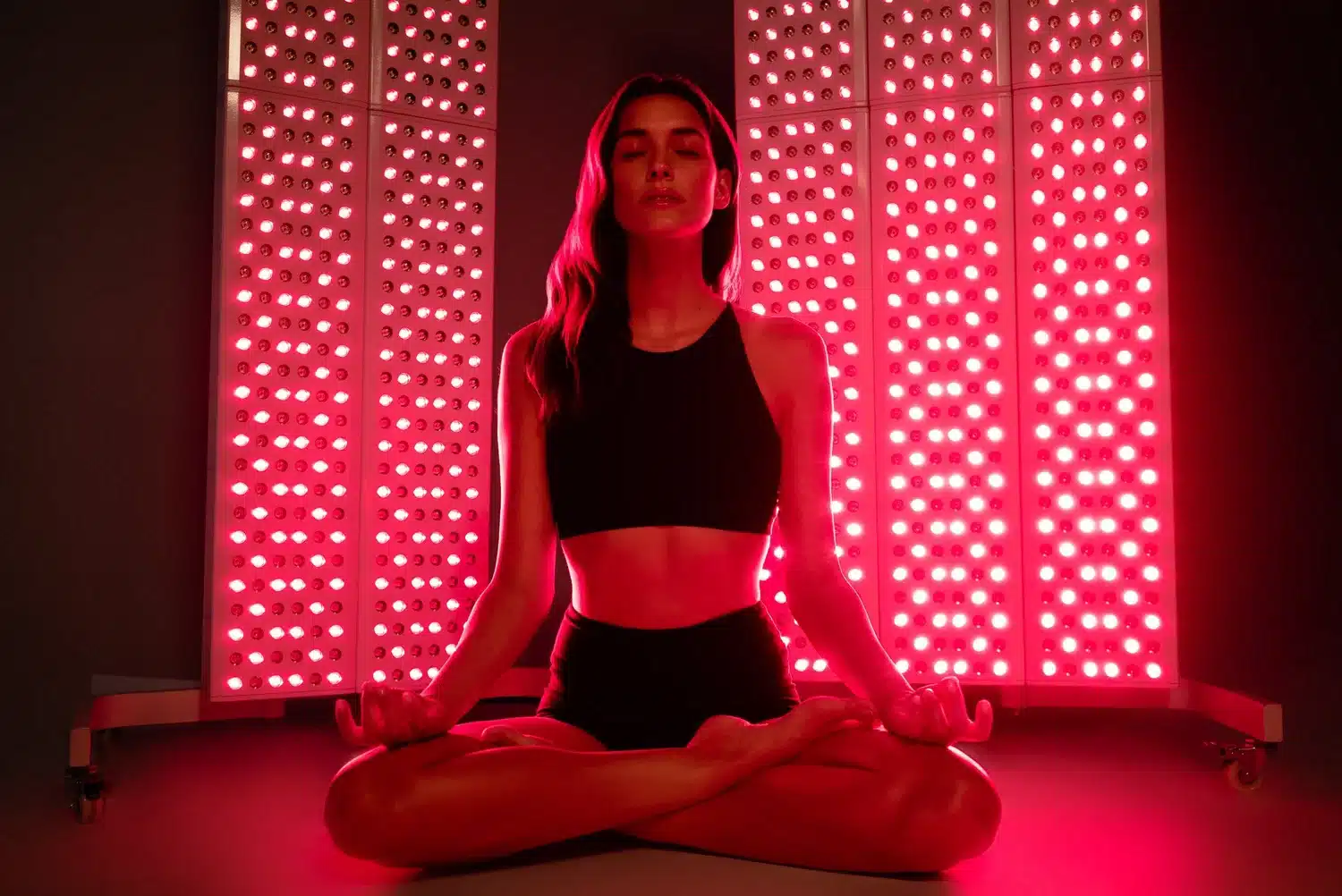
I position the BonCharge Max panel at chest height, approximately 8 inches from my torso. I sit in a low-back chair facing the panel, shirtless. The session starts within 15 minutes of waking — before any blue-light screen exposure, alongside natural morning light from an east-facing window when weather allows.
Minutes 1–3 are face-forward. The panel hits my face and chest at a slight oblique angle — never direct eye contact. The 660nm red light at this distance is absorbed primarily by superficial skin tissue and the retinal photoreceptors involved in circadian signal calibration. There is emerging evidence that red-wavelength light interacts with suprachiasmatic nucleus inputs differently than blue light — not suppressing melatonin, but reinforcing the morning cortisol peak that sets the rest of the hormonal day.
Minutes 3–7, I rotate 90 degrees and expose my right side — shoulder, hip, and lateral quadriceps. On alternating days I switch to the left. This targets the larger muscle groups most involved in the training load from the previous day, concentrating the photon dose where recovery demand is highest.
Minutes 7–10, I return face-forward and bring the panel 4–5 inches closer. The increased irradiance at this final stage drives a higher joule dose to the chest and sternum area, where proximity to the heart and bone marrow may support broader systemic effects through circulating blood irradiation.
The outcome, consistently tracked over 8 months via my Oura Ring Gen 4: deep sleep increases by an average of 14 minutes on nights following morning sessions, and my HRV baseline has climbed 11% over the tracking period. I am not claiming causation from an n=1 data set — but the signal is too consistent and too directional to ignore.
Pinterest Checklist: How to Build Your Red Light Recovery Nook
BLUF: A dedicated recovery space increases protocol consistency by removing friction — and consistency is what converts a hardware purchase into genuine physiological adaptation over time.
- ✅ Choose a room with east or south-facing natural light — stack red light therapy with morning sunlight to amplify the circadian anchor effect
- ✅ Install a panel mounting bracket or adjustable floor stand — hands-free positioning is essential for consistent treatment distance and angle
- ✅ Add a low-back meditation cushion or yoga mat — a seated or supine posture reduces session fidgeting and improves time-under-light compliance
- ✅ Use a blackout curtain on the opposing wall — minimizing ambient light interference keeps the photon signal clean during the session
- ✅ Place a Bluetooth speaker nearby — binaural beats or brown noise during sessions enhances the parasympathetic nervous system shift
- ✅ Keep your panel timer within arm’s reach — removing the need to reach for your phone eliminates the temptation to check notifications mid-session
- ✅ Enforce a no-screen rule for 10 minutes post-session — protect the circadian and neurological signal you just invested 10 minutes creating
- ✅ Pair with a recovery wearable (Oura Ring, WHOOP, Garmin) — data accountability is the single biggest long-term compliance driver I have observed in 4 years of biohacking
FAQ: Your Top Questions About the Best Red Light Therapy Panels
Can Red Light Therapy Improve Deep Sleep?
Yes — this is the evidence-backed claim I am most confident in. A 2019 randomized controlled trial involving Chinese national basketball team athletes documented a significant increase in melatonin levels and validated sleep quality scores following 14 consecutive days of 30-minute red light therapy at 630nm. The mechanism involves both direct melatonin pathway support in the pineal gland and reduced systemic cortisol via mitochondrial anti-inflammatory signaling.
Morning sessions are more effective than evening use for sleep enhancement. Morning red light sets a stronger circadian anchor that pays dividends at night. Evening sessions at 650–700nm are low enough in color temperature to avoid suppressing melatonin, but the morning protocol produces reliably better sleep data in my own 8-month tracking record.
How Far Should I Stand from a Red Light Therapy Panel?
The therapeutic sweet spot for most panels is 6–12 inches for maximum irradiance, and up to 24 inches for a lower-dose, larger-coverage-area protocol. For the BonCharge Max specifically — given its high irradiance output — I recommend 8–10 inches. Positioning closer than 6 inches adds thermal sensation without meaningfully increasing photobiological benefit.
How Long Until I Notice Results?
Acute effects — reduced muscle soreness, mild mood improvement, slightly faster wound healing at treated sites — are often perceptible within 2–3 days of consistent daily use. Structural adaptations — improved skin texture, measurable HRV increases, reduction in chronic joint discomfort — typically require 4–8 weeks of daily compliance at 10 or more minutes per session. The data tends to shift before you consciously feel the change, which is why pairing with a wearable is so valuable.
Is Daily Use Safe Long-Term?
For healthy adults, daily use is both safe and strongly recommended by the photobiomodulation research community. No established risks from daily red or NIR exposure at standard panel distances have been identified in the peer-reviewed literature. The primary contraindication involves photosensitizing medications — if you are taking certain antibiotics, retinoids, or lithium, consult your physician before beginning. The IEC 60601-1 certified Joovv Solo 3.0 is the most appropriate starting point for anyone managing a pre-existing health condition.
Final Verdict: Which of the Best Red Light Therapy Panels Is Right for You?
If you have read this far about the best red light therapy panels 2026, you likely already know where you fit. Let me make the decision clean.
Choose the BonCharge Max if raw therapeutic dose and recovery speed are your primary metrics. The greater than 142 mW/cm² irradiance is class-leading, the dual-chip LED technology is genuinely differentiated, and the 3-year warranty delivers excellent long-term value. This is the panel powering my own daily protocol.
Choose the PlatinumLED BIOMAX 600 if you are drawn to full-spectrum photobiomodulation — particularly for skin health, anti-aging protocols, or building a modular setup you can expand progressively. The 7-wavelength range is a meaningful differentiator, not a marketing story.
Choose the Joovv Solo 3.0 if IEC-certified safety, app-guided structured programming, or purchasing for someone managing a health condition are defining factors. You are paying for hospital-grade engineering, and that premium is entirely legitimate.
Whatever panel you choose: consistency is the real variable. A panel used every morning for six months will produce more physiological adaptation than a more expensive panel used twice a week. Build the nook, set the routine, show up every morning.