
By Sarah Lane, Wellness Editor — RelaxVitaLife
Reviewed by the RelaxVitaLife Editorial Team
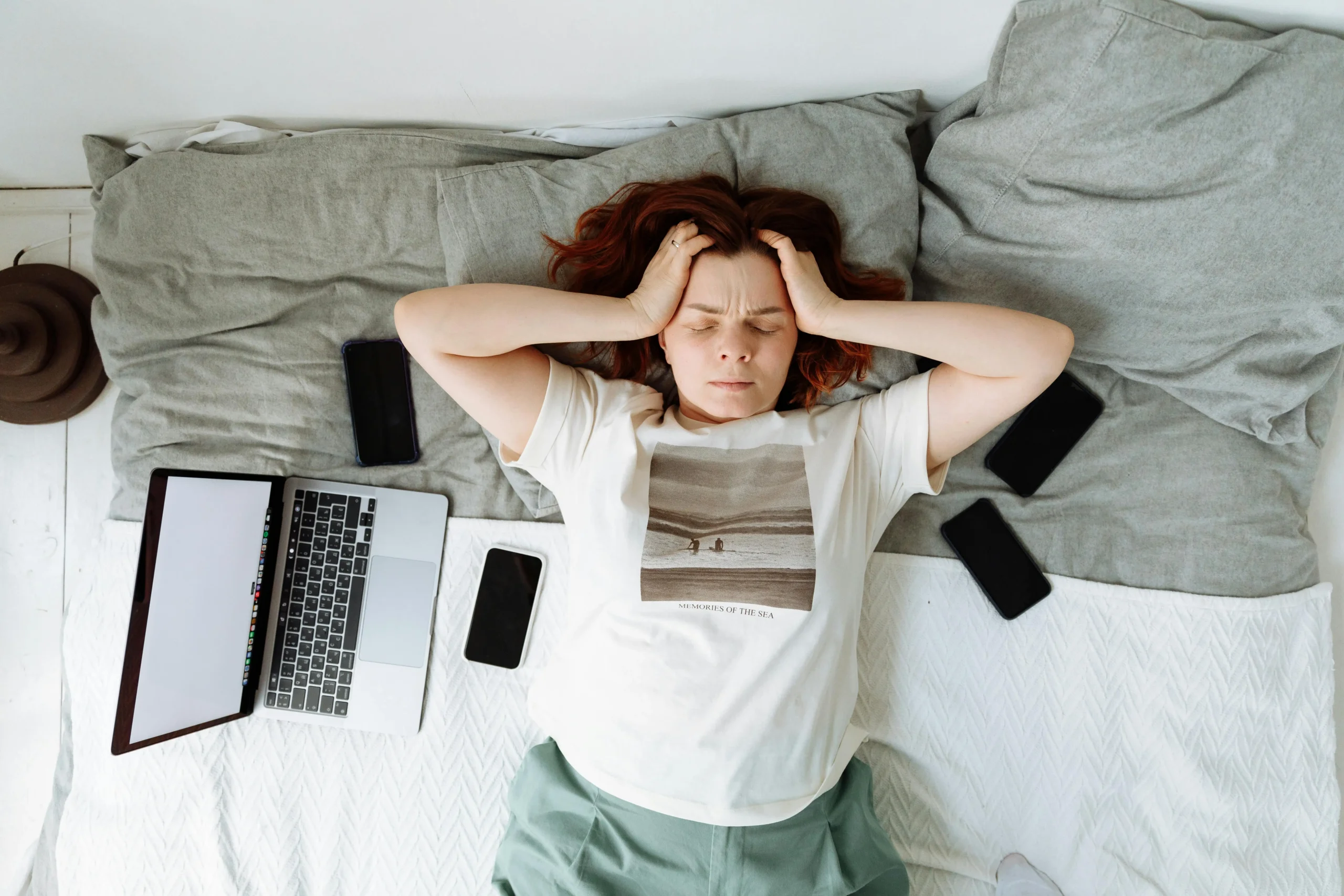
You finished work hours ago. The deadline is gone. The argument is over. And yet — your shoulders are still up near your ears, your jaw is tight, and your mind keeps replaying conversations you’ve already had.
This is the part of stress that rarely gets named: the leftover. The way your body keeps the alarm running long after the threat has passed. This is what makes it hard to calm your nervous system with generic advice — the alarm doesn’t respond to logic.
If that sounds familiar, you’re not broken. You’re stuck in something measurable, predictable, and — with the right inputs — reversible. This article is about what’s actually happening when your nervous system won’t switch off, why most generic advice (just relax, try yoga) tends to miss the point, and how to calm your nervous system when it’s been wired for too long.
The problem isn’t stress. It’s the aftermath of stress.
Acute stress is fine. Useful, even. Your heart rate climbs, your focus sharpens, and once the situation passes, your body recovers within minutes.
Chronic low-grade stress is different. It doesn’t end. It quiets down enough that you stop noticing it — until it shows up as poor sleep, tight breathing, irritability over small things, gut issues, or that wired-but-tired feeling that’s hard to explain to people who don’t have it. Knowing how to calm your nervous system in this state is more nuanced than standard advice suggests.
The mechanics underneath are straightforward. Your autonomic nervous system has two main branches: the sympathetic (“fight-or-flight”) and the parasympathetic (“rest-and-digest”). In a healthy rhythm, they trade off across the day. When you’re stuck, the sympathetic side stays elevated and the parasympathetic side never fully comes back online.
One of the more reliable signals that someone’s “off switch” isn’t working well is heart rate variability (HRV) — the small fluctuations between heartbeats. Lower HRV is consistently associated with poorer recovery from stress. It’s not a diagnostic tool, but it’s a useful window into how your system is coping.
Why most stress advice fails when you can’t calm your nervous system on demand
Look at any wellness feed and you’ll find the same list: meditate, exercise, journal, drink less caffeine, sleep more.
None of this is wrong. But here’s what tends to get missed.
The advice assumes you can access calm. If your nervous system is dysregulated, sitting still for ten minutes of meditation often makes things worse in the short term. The stillness isn’t restful — it’s exposing. A pattern shows up repeatedly across r/anxiety and r/meditation: beginners trying to meditate through high baseline arousal report increased restlessness and frustration, then conclude that meditation “doesn’t work for them.” It’s not the technique that failed. It’s the order.
Cognitive techniques can’t reach a body in survival mode. When the sympathetic system is dominant, the parts of your brain that handle abstract reasoning are deprioritized. Telling yourself this isn’t a real threat is technically true and practically useless if your physiology has already decided otherwise.
Generic advice ignores what got you here. Two people with the same symptoms may need very different interventions. Someone whose nervous system is stuck “on” because of poor sleep needs different inputs than someone stuck “on” because of unresolved relational stress, chronic inflammation, or thyroid dysfunction.
This isn’t a reason to dismiss the basics. It’s a reason to start somewhere more fundamental: signaling to your body that the threat is over — which is what it means to calm your nervous system properly.
What actually helps you calm your nervous system
The core insight from research on autonomic regulation is this: your body learns safety through repeated, specific physical signals — not through thoughts.
You can’t think your way out of a stuck stress response. You can give your body the kind of inputs it interprets as “safe enough to stand down.”
Below are the levers with the strongest evidence behind them — the ones that consistently show up across the research and across people who’ve actually managed to calm their nervous system after months or years of being stuck.
Slow exhales (longer than your inhale)
Of the breathing techniques studied for parasympathetic activation, slow-paced breathing is the most consistently supported — typically around 5–6 breaths per minute, with the exhale longer than the inhale.
The mechanism is well-understood: longer exhales stimulate the vagus nerve, which slows heart rate and shifts the body toward rest-and-digest mode. It’s the most direct way to calm your nervous system in real time, and unlike most interventions, it works in seconds.
A practical version: inhale for 4 seconds, exhale for 6–8 seconds, for 5 minutes. That’s it.
The effects per session are modest. The effects with consistent practice are not. People who do this once or twice a day for several weeks tend to report changes in baseline reactivity — not dramatic transformations, but real shifts in how quickly they recover from small stressors.
This is one of the few interventions where the gap between trying it once and practicing it for a month is enormous. Treat it as a daily input, not a tool you reach for in a crisis.
Cold exposure — but the boring kind
Cold exposure has produced more overstated claims than almost anything in wellness, but the underlying mechanism is sound: brief cold stimulates the vagus nerve and produces a parasympathetic rebound after the initial sympathetic spike.
You don’t need an ice bath. A 30-second cold rinse at the end of a normal shower is enough to produce the rebound effect for most people. The point isn’t the cold itself — it’s training your body to recover from a small, controlled stressor, which strengthens the recovery pathway. For anyone working to calm their nervous system after prolonged stress, this rebound effect is worth understanding.
If you’re curious how cold compares to heat therapy for recovery, our cold plunge vs. sauna breakdown covers the current evidence. A real safety note: people with cardiovascular conditions, Raynaud’s, or arrhythmias should talk to a doctor before adding cold exposure. Individual variation matters here more than the trendy framing suggests.
Long, slow, low-intensity movement
High-intensity exercise has clear long-term benefits. In the short term, though, it adds to your sympathetic load. For someone already running hot, daily HIIT can keep the system stuck “on” rather than help it reset.
What helps more, especially in the early phase: walking. Boring, unhurried, ideally outdoors, ideally without a podcast. 30–45 minutes a day. The combination of rhythmic movement, daylight, and low cognitive demand seems to do something more “optimized” workouts don’t. It gives the body a signal it rarely gets during high-intensity work: that it’s safe to calm your nervous system, not rev it up.
A pattern across stress and anxiety forums is striking on this: people who replaced their daily intense workout with a long walk for 4–6 weeks consistently report sleep and mood improvements that surprised them. It’s not that the walk is magic. It’s that, for an already-overloaded system, the absence of additional load is what allows recovery. Slow, unhurried walks are one of the simplest ways to calm your nervous system without adding more demand to it.
Sleep — but specifically the first 90 minutes
Most stress-and-sleep advice focuses on duration. The more useful target, if you’re nervous-system-dysregulated, is how deeply you sleep in the first sleep cycle.
Slow-wave sleep — the deep, restorative kind — is concentrated in the first half of the night. If you’re going to bed wired, you’ll get less of it. And that’s the part of sleep that does the heaviest lifting for downregulating the stress response and consolidating emotional memory. If your goal is to calm your nervous system overnight, the quality of that first sleep cycle matters more than total hours. The science of deep recovery sleep explains exactly why that window is so critical.
For a practical breakdown of how to structure the hour before bed, our 90-minute evening routine for better sleep goes deeper on this. Practical implications:
- A screen-free 30–45 minutes before bed matters more than going to bed earlier.
- Bedroom temperature matters; the research clusters around 18°C / 65°F.
- Alcohol — even one drink — measurably reduces deep sleep. Worth knowing if you’ve been using it to “wind down.”
Connection and co-regulation
This one gets less attention because it’s harder to package — and harder to calm your nervous system without — but it may be the most powerful lever — and possibly the most direct way to calm your nervous system that doesn’t involve any protocol.
Humans regulate through other humans. A calm conversation with someone you trust, a long hug, time with a relaxed pet, even sitting in a room with someone whose nervous system is steadier than yours — these aren’t soft suggestions. They’re physiological inputs.
Chronic stress often deepens during periods of isolation, even when nothing else has changed. And the people who recover fastest from stuck stress states tend to have at least one consistent source of co-regulation in their daily life. If that’s missing for you right now, treat finding it as part of the work — not a separate problem.
A simple weekly framework to calm your nervous system
A low-friction structure that combines the levers above:
Daily, non-negotiable:
- 5 minutes of slow-exhale breathing (mornings work better than evenings for most people; pick one and stick with it)
- A 30-minute walk, ideally outdoors, ideally without input
Three times per week:
- 30 seconds of cold rinse at the end of your shower
- One conversation, in person or by phone, with someone whose company calms you down
Sleep environment:
- 30 minutes of dim light before bed
- Bedroom cool and dark
- Phone outside the bedroom if possible
That’s the whole framework. No supplements. No apps. No tracking. It’s designed to calm your nervous system through accumulated input, not to feel impressive on any given day.
The reason it works isn’t the individual elements — it’s the consistency. Your nervous system learns from repetition, not intensity. That consistency is how you calm your nervous system sustainably — not through a single effort, but through steady inputs over weeks.
Most people notice some improvement within 2–3 weeks. Real baseline change usually takes 6–8 weeks of steady input. If you’re not seeing any shift after that, the cause is probably not lifestyle alone, and it’s worth a conversation with a qualified clinician — for example, the CDC’s guidance on coping with stress is a reasonable next read.
When to look beyond self-management
A reset like this is reasonable for low-to-moderate chronic stress. It is not a substitute for professional care if you’re dealing with:
- Persistent panic attacks
- Trauma symptoms (intrusive memories, dissociation, hypervigilance that doesn’t ease)
- Sleep that hasn’t been functional for weeks
- Stress accompanied by significant changes in mood, appetite, or motivation
Chronic stress and anxiety disorders sit on a continuum, but they aren’t the same thing, and the tools that help one don’t always help the other. If something feels bigger than what’s described here, it probably is — and a therapist or physician is the right starting point, not another article.
The honest part
There’s no version of this where you do five breathing exercises and feel transformed. The things that actually calm your nervous system are almost always boring — repeated, unglamorous, and slow to show results.
Most of what works is unglamorous: walking, sleeping, breathing slowly, talking to people you like, getting brief cold exposure, then doing it again the next day. The compounding is real, but it’s slow, and it asks you to trust a process that doesn’t show its work immediately.
The encouraging part is that nervous systems are responsive. They learn. They adapt. The same plasticity that got you stuck is the plasticity that lets you get unstuck — provided the inputs are consistent enough and specific enough.
Start with one thing. The 5-minute breathing practice is the highest-leverage place to begin, because it requires nothing and works regardless of context. Whether you’ve been dysregulated for weeks or months, the steps to calm your nervous system are the same — and they don’t require perfect conditions. The simplest path to calm your nervous system starts with a longer exhale than inhale, repeated daily. Add the walk when that feels automatic. Build from there.
Your body has been waiting for a signal that it’s safe to stand down. Your job, mostly, is to keep sending it.
About the Author
Sarah Lane is a Wellness Editor at RelaxVitaLife. Her work focuses on the intersection of stress physiology, daily habits, and the gap between what wellness content claims and what the evidence actually supports. She writes by aggregating peer-reviewed research, clinical reviews, and patterns from real-world community discussion.
This article was reviewed by the RelaxVitaLife Editorial Team. The information here is educational and is not a substitute for medical advice. If you’re experiencing persistent or severe stress symptoms, please consult a qualified healthcare professional.